Article
Growth & Facial Asymmetry: When to Worry
Only a few dentists can notice it and realize the asymmetry can signal an underlying skeletal imbalance, a growth issue, or a functional shift that will later cause orthodontic complexity.
Here’s a detailed guide on how to catch it early and when to act so that more dentists can spot the red flag.
Why Asymmetry Deserves Attention?
Facial asymmetry is common, but significant asymmetry can have big implications.
Recent studies show that up to one third orthodontic patients show measurable skeletal asymmetry, often associated to mandibular deviation, functional crossbites, or TMJ loading differences1.
Ignoring early skeletal imbalance can lead to:
- Distorted occlusal development
- Compensatory dental tipping
- Increased TMJ dysfunction risk
- Complicated orthodontic or surgical correction later on
Clinical refernce: if detected before the growth spurt, most asymmetries can be intercepted with simpler orthodontic guidance. After growth happens, the same problem may need orthognathic intervention.
Chairside Clues You Should Never Miss
Below are a few signs you should note2 -
Alhammadi MS, Halboub E, Fayed MS, Labib A, El-Saaidi C. Global distribution of malocclusion traits: a systematic review. Dental Press J Orthod. 2018 Nov-Dec;23(6):40.e1-40.e10.
Facial and Extraoral Signs
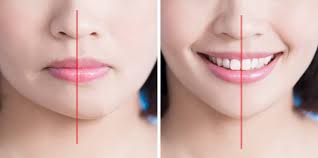
- Chin point deviating approximately 4 mm from the midline.
- Uneven ear heights or cheekbone prominence.
- Head tilt or a habitual face-turn in photos.
Intraoral and Occlusal Signs
- Deviation in upper and lower dental midlines.
- Unilateral posterior crossbite or scissor bite.
- Smile line not parallel to interpupillary line.
- Functional shift - patient slides the jaw to achieve intercuspation.
If you suspect asymmetry, take a PA ceph or CBCT to differentiate skeletal vs dento-alveolar origin3.
You can evaluate condylar height, mandibular length, and dental arch coordination.
When to Worry?
These can be a few red flags you should look out for4 -
- Any visible facial deviation increasing over 6–12 months
- Crossbite or occlusal cant developing on one side
- Chin or dental midline shift of more than 4–5 mm
- Asymmetry in a growing child from ages 8–13
If this is the case, document the current status and refer to the specialist. Early collaborative planning can often redirect growth patterns and prevent surgical outcomes.
Chairside Implementation Tips
Here are a few tips you should keep in mind -
Document everything
Include chin-to-midline notes, facial photos, and occlusal cants in your chart.
Educate parents/patients
Use simple language to explain to the patients. Put it in understandable language, like “Her chin is growing slightly to one side, and this could affect how her jaws align if we don’t monitor it.”
Schedule structured reviews
6-month growth checks during mixed dentition can help notice progression well on time.
Have a referral protocol
Collaborate with orthodontic dentists. Have clarity on situations that could lead to referral.
Why This Matters?
Many dentists miss asymmetry because it’s subtle and patients rarely complain. Yet, it needs to be understood that these are exactly the cases that turn complex later5.
By building a simple 2-minute “symmetry check” into every mixed-dentition exam, you:
✅ Catch skeletal issues early
✅ Reduce treatment invasiveness
✅ Strengthen interdisciplinary trust
Final Takeaway
Facial asymmetry isn’t just aesthetic. It’s an orthodontic red flag and your early eye can change the patient’s entire treatment trajectory.
References (Vancouver style):
- Zhu Y, Zhao Y, Wang Y. A review of three-dimensional facial asymmetry analysis methods. Symmetry (Basel). 2022;14(7):1414.
- Alhammadi MS, Halboub E, Fayed MS, Labib A, El-Saaidi C. Global distribution of malocclusion traits: a systematic review. Dental Press J Orthod. 2018 Nov-Dec;23(6):40.e1-40.e10.
- Pedersoli L, Dalessandri D, Tonni I, Bindi M, Isola G, Oliva B, Visconti L, Bonetti S. Facial asymmetry detected with 3D methods in orthodontics: A systematic review. Open Dent J. 2022 Apr 25;16:e2111251.
- American Academy of Pediatric Dentistry. Management of the developing dentition and occlusion in pediatric dentistry. In: The Reference Manual of Pediatric Dentistry. Chicago (IL): American Academy of Pediatric Dentistry; 2024. p. 475–93.
- Adel M, Hunt KJ, Lau D, Hartsfield JK, et al. Precision assessment of facial asymmetry using 3D imaging and artificial intelligence. J Clin Med. 2025;14(20):7172
Related Contents
Article
Prosthetic Design Factors That Prevent Peri-Implant Bone Loss
You placed the implant perfectly. Osseointegration was flawless. But three years later, there is 3mm...
Article
Treatment Algorithms for Peri-Implant Mucositis and Peri-Implantitis
You can prevent most peri-implant disease. But once it develops, treatment becomes less predictable....
Article
Implant Surface Decontamination: What Actually Works
Treating peri-implantitis starts with one critical step, which is decontaminating the implant surfac...
Article
Orthodontic Red Flags Every Dentist Should Recognize: Functional Habits and Airway Cues
Some malocclusions cases stall for reasons you can’t see on a scan, as not...
Article
Tooth Eruption & Space Management: What Orthodontists Should Watch For
Tooth eruption may not alwaxfys fit the predictable biological timeline. A delayed or ecto...
Article
Communication & Referral Timing: Getting It Right
You have identified a problem, maybe a severe Class III malocclusion in a 9-year-old, or it is an im...
Article
Rotary File Fatigue – How to Prevent Separation?
File breakage in maxillary molars is not a rare sight, but definitely no less than a nightmare. But...
Article
Modern Irrigation Activation: Ultrasonic vs Sonic vs Laser
After shaping the canal, irrigation determines whether bacteria will stay or be washed away. ...