Article
Implant Surface Decontamination: What Actually Works
Treating peri-implantitis starts with one critical step, which is decontaminating the implant surface.
The market is flooded with options. Lasers, air-polishing systems, titanium brushes, ultrasonic devices, chemical agents, you name it.
Each manufacturer claims superiority. But what does the evidence actually show?
The 2024 AO/AAP Consensus just published a systematic review analyzing the efficacy of different decontamination methods for biofilm removal and reosseointegration. Here is what you need to know.
The Foundation: Mechanical Debridement Is Non-Negotiable
Evidence from in vivo studies shows that systemic antibiotics alone are ineffective for implant surface decontamination. It highlighted the importance of manual debridement to eliminate biofilm and resolve peri-implant lesions.
No chemical agent or laser can replace a thorough mechanical biofilm removal. Therefore, every treatment protocol must start here.
What the Evidence Shows About Reosseointegration?
Reosseointegration is basically re-establishment of bone-to-implant contact. It can be achieved by following appropriate decontamination. It has been seen that bone-to-implant contact and vertical bone gains vary a lot.
The results are unpredictable, even with optimal decontamination. Therefore, you should manage patient expectations accordingly and clearly set the expectations.
Methods That Show Promise
Air-Polishing Devices
Air-polishing devices frequently yield favorable reosseointegration outcomes.
What the research shows? Air abrasive systems with powders like glycine, sodium bicarbonate, and calcium carbonate can effectively remove biofilm, though harder powders tend to cause more surface damage than glycine.
Clinical consideration: There is a a little imbalance between cleaning efficacy and surface alteration. For eg, sodium bicarbonate and calcium carbonate are more effective but cause more surface change than glycine would.
Lasers (Er:YAG and Er,Cr:YSGG)
Controlled laser applications, particularly Er:YAG and Er,Cr:YSGG lasers, frequently yield favorable reosseointegration outcomes.
What the research shows? Er:YAG laser was more effective than curettes and titanium brushes in killing biofilm bacteria, though titanium brushes were more effective at removing organic contaminants.
Clinical consideration: Laser parameters matter at higher energy settings can damage titanium surfaces, particularly sandblasted and acid-etched (SLA) surfaces Don’t forget to use conservative settings.
Methods With Limited High-Level Evidence
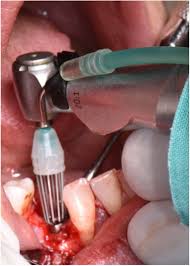
High-level evidence on the effect of implantoplasty, PEEK ultrasonic tips, and titanium brushes used as monotherapies is limited.
This doesn't mean that they don't work, it simply means we lack sufficient clinical trial data to confirm their effectiveness as standalone treatments.
Titanium Brushes
Titanium brushes achieved greater elimination of organic contaminants than curettes and Er:YAG laser, though none completely eliminated surface contamination.
Titanium brushes have shown positive results as a single decontamination method in some studies.
Clinical consideration: Titanium brushes are effective for mechanical cleaning but may alter surface structure.
What Doesn't Work Alone
Systemic antibiotics alone are mostly ineffective to achieve sufficient implant surface decontamination.
Antibiotics have a role as adjuncts in severe cases, but they cannot replace mechanical debridement.
Reality Check
Meta-analyses indicated a lack of added effect of Er:YAG laser on probing pocket depth reduction, though systemic antimicrobials showed added effect on short-term treatment success.
None of the tested decontamination techniques was able to completely eliminate surface contamination or restore original surface chemistry.
Complete biofilm elimination is nearly impossible. The goal is to reduce the decontamination that may allow healing and disease resolution.
Your Evidence-Based Protocol
Based on the 2024 consensus, here is what you can do:
- Start with mechanical debridement first with the help of curettes, titanium brushes, or go in for air-polishing
- Consider adjunctive lasers like Er:YAG at conservative settings, for enhanced decontamination
- Prescribe systemic antibiotics only in severe cases or high-risk patients
- Chemical agents alone cannot do the needful, remember they are adjuncts and not replacement.
- Surface type matters: Rougher surfaces are harder to decontaminate than machined ones. You need to adjust expectations and techniques accordingly.
Final Takeaway
The 2024 AO/AAP Consensus makes one thing clear: no single decontamination method demonstrates superiority over all others.
Air-polishing and controlled laser applications show promise for reosseointegration. Titanium brushes effectively remove organic contaminants. But complete decontamination remains difficult to achieve with any method.
And remember: the best "decontamination protocol" is prevention. Risk stratification, proper prosthetic design, and rigorous maintenance prevent more peri-implantitis than any treatment ever will.
References
- Wang HL, Avila-Ortiz G, Monje A, Kumar P, Calatrava J, Aghaloo T, et al. AO/AAP consensus on prevention and management of peri-implant diseases and conditions: Summary report. J Periodontol. 2025;96(6):519-86. Available from:
- Ravidà A, Dias DR, Lemke R, Rosen PS, Bertolini MM. Efficacy of decontamination methods for biofilm removal from dental implant surfaces and reosseointegration: An AAP/AO systematic review on peri-implant diseases and conditions. Int J Oral Maxillofac Implants. 2025;(4):91-160.
Related Contents
Article
Prosthetic Design Factors That Prevent Peri-Implant Bone Loss
You placed the implant perfectly. Osseointegration was flawless. But three years later, there is 3mm...
Article
Treatment Algorithms for Peri-Implant Mucositis and Peri-Implantitis
You can prevent most peri-implant disease. But once it develops, treatment becomes less predictable....
Article
Growth & Facial Asymmetry: When to Worry
Only a few dentists can notice it and realize the asymmetry can signal an underlying skeletal imbala...
Article
Orthodontic Red Flags Every Dentist Should Recognize: Functional Habits and Airway Cues
Some malocclusions cases stall for reasons you can’t see on a scan, as not...
Article
Tooth Eruption & Space Management: What Orthodontists Should Watch For
Tooth eruption may not alwaxfys fit the predictable biological timeline. A delayed or ecto...
Article
Communication & Referral Timing: Getting It Right
You have identified a problem, maybe a severe Class III malocclusion in a 9-year-old, or it is an im...
Article
Rotary File Fatigue – How to Prevent Separation?
File breakage in maxillary molars is not a rare sight, but definitely no less than a nightmare. But...
Article
Modern Irrigation Activation: Ultrasonic vs Sonic vs Laser
After shaping the canal, irrigation determines whether bacteria will stay or be washed away. ...