Article
Latest Irrigation Protocols in Endodontics That Improve Root Canal Treatment Success
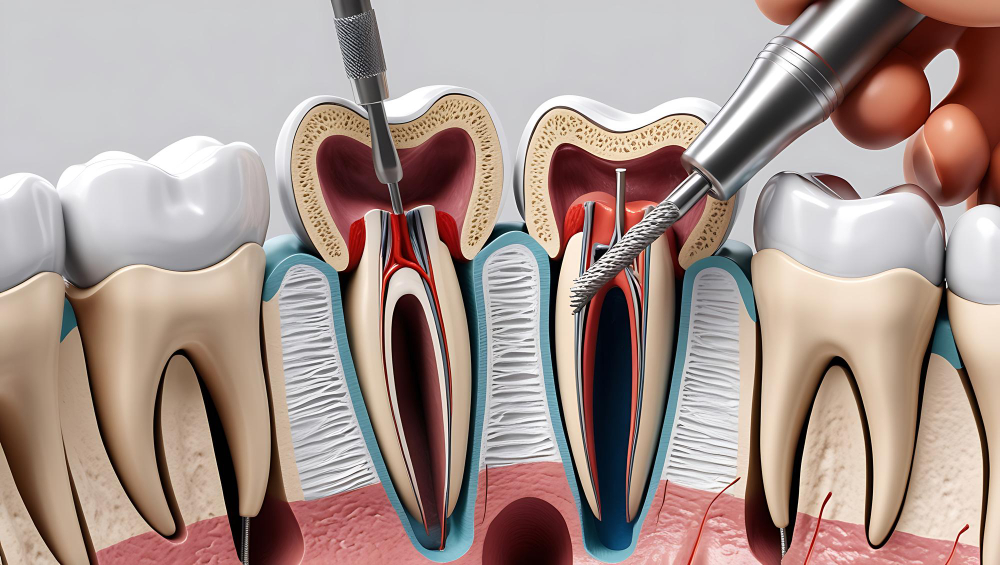
Shaping the canal is the most discussed aspect, but we often overlook the crucial role of irrigation in root canal success.
Irrigants work their magic by dissolving necrotic tissue, disrupting resilient biofilms, and removing the smear layer that mechanical files leave behind.
Why Irrigation Is Critical in Root Canal Therapy?
Root canals come with accessory canals, lateral canals, isthmuses, and dentinal tubules that files alone cannot reach.
Failure to adequately disinfect these areas significantly contributes to endodontic failure1.
Core Components of the Latest Irrigation Protocol
- Sodium Hypochlorite (NaOCl): The Cornerstone Irrigant
Sodium hypochlorite continues to be the most effective irrigant due to its broad-spectrum antimicrobial action and ability to dissolve necrotic tissue.
Contemporary protocols recommend concentrations between 2.5% and 5.25%, balancing antimicrobial potency and biocompatibility2.
It is important to note that higher concentrations improve tissue dissolution but increase cytotoxicity risk, which emphasizes the need for controlled delivery.
- EDTA and Smear Layer Removal
The smear layer, formed during instrumentation, often occludes dentinal tubules and harbors bacteria.
A 17% EDTA solution applied for 1–3 minutes effectively removes this layer, enhancing irrigant penetration and sealer adaptation.
More recently, agents such as QMix, combining EDTA and chlorhexidine, have been used to remove the smear layer while also providing antibacterial action.3.
- Irrigant Activation Techniques
Passive irrigation is insufficient for thorough canal debridement. Activation improves irrigant penetration into canal complexities:
- Passive Ultrasonic Irrigation (PUI): Ultrasonic tips vibrate at 25-30 kHz, creating acoustic streaming and cavitation that enhances debris removal and bacterial reduction. Studies report better canal wall cleanliness with PUI compared to conventional irrigation4.
- Sonic Activation: Devices such as the EndoActivator provide lower-frequency agitation, effectively increasing irrigant flow and cleaning efficacy in curved and narrow canals5.
- Laser-Activated Irrigation: Photon-induced photoacoustic streaming (PIPS) utilizes Er:YAG lasers to activate irrigants, facilitating the removal of smear layers and reducing bacterial growth6.
- Negative Pressure Irrigation (EndoVac): Instead of pushing irrigants forcefully into the canal, EndoVac uses gentle suction to draw the cleaning solution all the way down to the tip of the root.
This approach not only reduces the risk of irrigant being pushed beyond the root, which can cause discomfort and complications, but also ensures more effective cleaning, especially in the hard-to-reach apical third of the canal.
Studies show that this negative pressure system enhances irrigant flow and helps achieve a cleaner canal without the risk of extrusion7.
- Optimized Irrigation Sequence
The latest evidence supports an alternating irrigation sequence:
- Irrigation with 2.5–5.25% NaOCl during instrumentation for continuous tissue dissolution and antimicrobial action.
- Final rinse with 17% EDTA for 1–3 minutes to remove smear layer.
- Followed by a final flush with NaOCl or sterile saline to clear residual debris.
This sequence is critical, as EDTA exposure before NaOCl can diminish NaOCl’s effectiveness due to chemical interactions8.
- Emerging Irrigants and Adjuncts
A few emerging novel irrigants and adjuncts are:
- MTAD (mixture of doxycycline, citric acid, and detergent) shows effective smear layer removal and antimicrobial properties.
A 2024 study found that MTAD exhibited superior residual antibacterial substantivity over 28 days compared to 2% chlorhexidine (CHX) and 2% chitosan, but is limited by antibiotic resistance concerns9.
- Chlorhexidine gluconate offers sustained antimicrobial action but lacks tissue-dissolving capabilities and may form precipitates when mixed with sodium hypochlorite (NaOCl), which may ultimately affect canal cleanliness.
- Natural irrigants like neem extract and green tea polyphenols demonstrate antimicrobial effects in vitro but require more clinical validation.
Practical Recommendations for Clinicians
- Use side-vented irrigation needles to reduce the risk of irrigant extrusion and periapical tissue damage.
- Avoid excessive pressure during irrigation; instead, focus on gentle delivery coupled with activation.
- Employ ultrasonic or sonic activation wherever feasible to enhance cleaning efficiency, especially in complex canal anatomies.
- Tailor irrigant concentration and volume to the case complexity and canal morphology.
- Adhere strictly to recommended irrigant contact times to maximize efficacy without damaging dentinal structures.
Final Thoughts
The latest irrigation protocols integrate powerful irrigants, innovative activation techniques, and evidence-based sequences to optimize canal disinfection and treatment outcomes.
By embracing these advances, clinicians can significantly reduce endodontic failure rates and improve long-term patient prognosis.
Reference
- Iqbal A. The factors responsible for endodontic treatment failure in the permanent dentitions of the patients reported to the College of Dentistry, the University of Aljouf, Kingdom of Saudi Arabia. J Clin Diagn Res. 2016 May 1;10(5):ZC146–ZC148.
- Ghivari SB, Bhattacharya H, Bhat KG, Pujar MA. Antimicrobial activity of root canal irrigants against biofilm forming pathogens - An in vitro study. J Conserv Dent. 2017 May-Jun;20(3):147–151
- Stojicic S, Shen Y, Qian W, Johnson B, Haapasalo M. Antibacterial and smear layer removal ability of a novel irrigant, QMiX. Int Endod J. 2012;45(4):363–371
- Guerreiro-Tanomaru JM, Chávez-Andrade GM, de Faria-Júnior NB, Watanabe E, Tanomaru-Filho M. Effect of passive ultrasonic irrigation on Enterococcus faecalis from root canals: an ex vivo study. Braz Dent J. 2015 Jul-Aug;26(4):342-6.
- Kharouf N, Pedullà E, La Rosa GRM, Bukiet F, Sauro S, Haikel Y, Mancino D. In vitro evaluation of different irrigation protocols on intracanal smear layer removal in teeth with or without pre-endodontic proximal wall restoration. J Clin Med. 2020 Oct 16;9(10):3325
- Olivi G, Genovese C, Campagna E, Tempera G, Rapisarda E. Disinfection efficacy of photon-induced photoacoustic streaming on root canals infected with Enterococcus faecalis: an ex vivo study. J Am Dent Assoc. 2014 Oct;145(10):843-8.
- van der Sluis LW, Versluis M, Wu MK, Wesselink PR. Passive ultrasonic irrigation of the root canal: a review of the literature. Int Endod J. 2007 Jun;40(6):415-26.
- Vianna ME, Gomes BPFA, Berber VB, Zaia AA, Ferraz CC, de Souza-Filho FJ. In vitro evaluation of the antimicrobial activity of chlorhexidine and sodium hypochlorite. Oral Surg Oral Med Oral Pathol Oral Radiol Endod. 2004;97(1):79–84.
- Sonisha S, Gaffoor FMA, Gopakumar R, Girish CS, Mohan R, Anoop VN. Comparative evaluation of residual antibacterial substantivity of chlorhexidine, MTAD and chitosan against Enterococcus faecalis in human root dentin: An in vitro study. J Pharm Bioallied Sci. 2024 Apr;16(Suppl 2):S1400–S1403.
Related Contents
Video
Management of Traumatic Tooth Avulsion: When & How?
Traumatic tooth avulsion is a true dental emergency requiring immediate and structured management to...
Article
Prosthetic Design Factors That Prevent Peri-Implant Bone Loss
You placed the implant perfectly. Osseointegration was flawless. But three years later, there is 3mm...
Article
Treatment Algorithms for Peri-Implant Mucositis and Peri-Implantitis
You can prevent most peri-implant disease. But once it develops, treatment becomes less predictable....
Article
Implant Surface Decontamination: What Actually Works
Treating peri-implantitis starts with one critical step, which is decontaminating the implant surfac...
Article
Growth & Facial Asymmetry: When to Worry
Only a few dentists can notice it and realize the asymmetry can signal an underlying skeletal imbala...
Article
Orthodontic Red Flags Every Dentist Should Recognize: Functional Habits and Airway Cues
Some malocclusions cases stall for reasons you can’t see on a scan, as not...
Article
Tooth Eruption & Space Management: What Orthodontists Should Watch For
Tooth eruption may not alwaxfys fit the predictable biological timeline. A delayed or ecto...
Article
Communication & Referral Timing: Getting It Right
You have identified a problem, maybe a severe Class III malocclusion in a 9-year-old, or it is an im...